


As shown in Image 1, computer vision is no longer a futuristic concept—it’s actively interpreting traffic, identifying pedestrians, and optimizing decisions in real time. From autonomous vehicles to medical diagnostics and smart retail analytics, computer vision is reshaping industries.
For software engineers, AI enthusiasts, and product managers, this is more than just another AI buzzword. It’s a foundational capability driving next-gen SaaS platforms, edge AI computer vision systems, and cloud-native products.
In this comprehensive guide, we’ll explore:
- What computer vision really is (beyond the hype)
- Core algorithms and deep learning techniques
- Real-world use cases you can deploy today
- Tools like OpenCV, PyTorch, and YOLO object detection
- Edge deployment challenges
- Vision Transformers and Vision-Language Models (VLMs)
- Hands-on computer vision projects you can build now
Let’s dive in.
What is Computer Vision?
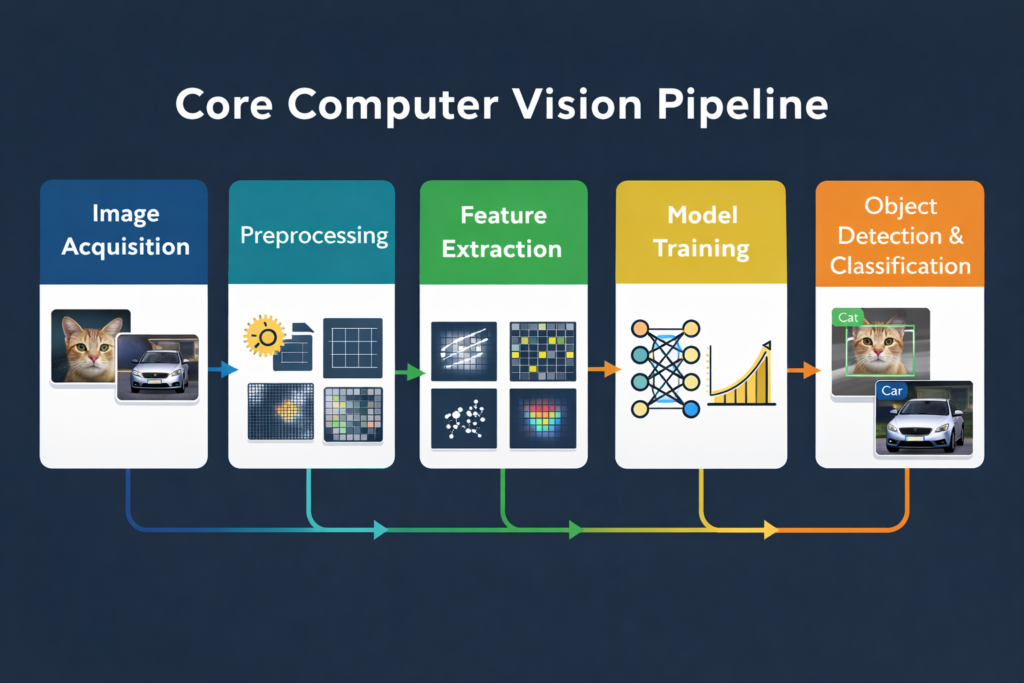
Computer vision is a field of artificial intelligence that enables machines to interpret and make decisions based on visual data—images or video streams.
At its core, the pipeline (shown in Image 2) typically follows:
- Image Input
- Preprocessing
- Feature Extraction
- Model Inference
- Output / Decision Layer
Traditional vs Deep Learning-Based Vision
Historically, computer vision relied on handcrafted features:
- SIFT (Scale-Invariant Feature Transform)
- SURF
- HOG (Histogram of Oriented Gradients)
- Edge detection (Canny)
Modern systems use deep learning:
- Convolutional Neural Networks (CNNs)
- YOLO object detection
- Vision Transformers (ViTs)
Instead of manually defining edges or shapes, models learn patterns directly from data.
Why It Matters for Product Teams
For product managers:
- Enables automation at scale
- Reduces human intervention
- Unlocks monetizable features (e.g., analytics dashboards)
For engineers:
- Combines data pipelines + ML + systems engineering
- Integrates with edge devices and cloud-native architectures
Core Techniques and Algorithms
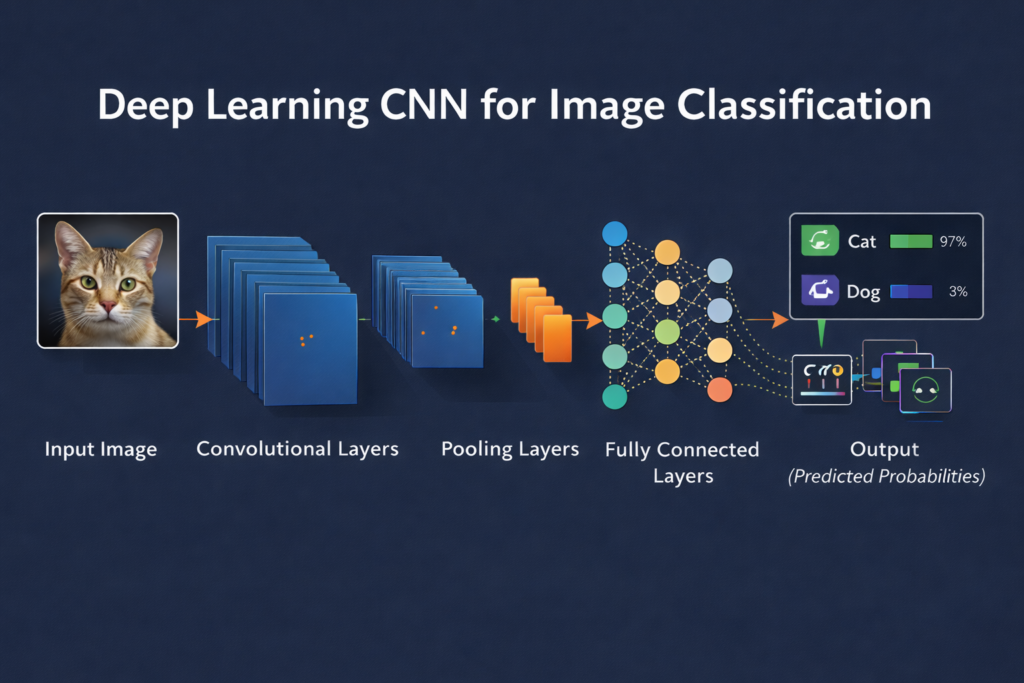
Deep learning revolutionized computer vision through CNNs (see Image 3).
1. Image Classification
Assigns a single label to an image.
Example:
- Cat vs Dog classifier
- Disease detection in X-rays
Common architectures:
- ResNet
- EfficientNet
- MobileNet (for edge AI computer vision)
2. Object Detection
Detects multiple objects and draws bounding boxes.
Popular frameworks:
- YOLO object detection
- Faster R-CNN
- SSD
Example: PPE detection on factory floors.
3. Image Segmentation
Pixel-level understanding.
- Semantic segmentation
- Instance segmentation (Mask R-CNN)
Used in:
- Medical imaging
- Autonomous driving
4. Face Recognition
Pipeline:
- Face detection
- Feature embedding extraction
- Similarity comparison
Applications:
- Secure access systems
- Smart attendance solutions
5. Tracking and Video Analytics
Used for:
- Traffic analytics
- Retail behavior insights
- Sports analytics
Combines detection + motion tracking + temporal modeling.
Real-World Applications
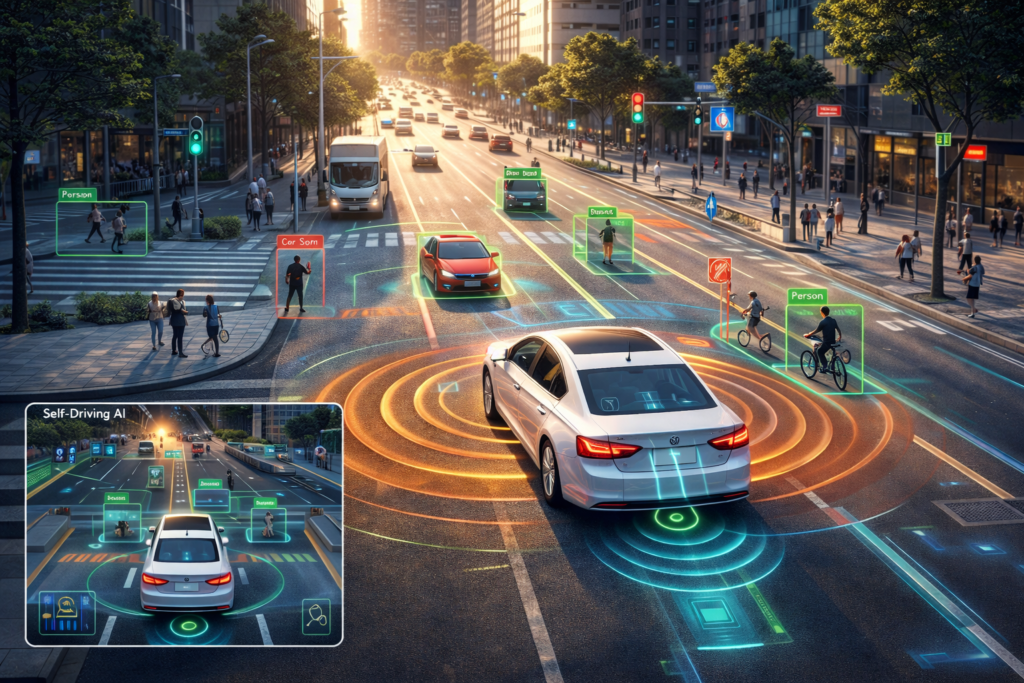
As shown in Image 4, autonomous vehicles rely heavily on computer vision.
1. Autonomous Vehicles
- Lane detection
- Pedestrian detection
- Traffic sign recognition
Companies integrate multi-camera systems + LiDAR + deep neural networks.
2. Healthcare & Medical Imaging
- Tumor detection
- Retinal disease analysis
- Radiology automation
CNN-based classifiers often outperform traditional image analysis.
3. Retail & Smart Surveillance
- People counting
- Shelf analytics
- Theft detection
Edge AI computer vision systems process video locally for privacy.
4. Manufacturing & Industrial Automation
- Defect detection
- Quality control
- PPE detection systems
These are ideal computer vision projects for enterprise SaaS platforms.
5. Agriculture
- Crop health monitoring
- Disease detection
- Drone-based imaging
Tools & Frameworks You Should Know

The ecosystem is mature and production-ready.
1. OpenCV
Best for:
- Rapid prototyping
- Image preprocessing
- OpenCV tutorials for beginners
Example: Face detection in Python
import cv2

# Load pre-trained model
face_cascade = cv2.CascadeClassifier(
    cv2.data.haarcascades + 'haarcascade_frontalface_default.xml'
)

img = cv2.imread('image.jpg')
gray = cv2.cvtColor(img, cv2.COLOR_BGR2GRAY)

faces = face_cascade.detectMultiScale(gray, 1.3, 5)

for (x, y, w, h) in faces:
    cv2.rectangle(img, (x, y), (x+w, y+h), (255, 0, 0), 2)

cv2.imshow('Face Detection', img)
cv2.waitKey(0)
cv2.destroyAllWindows()
This is one of the simplest computer vision projects to get started.
2. PyTorch / TensorFlow
Best for:
- Model training
- Custom architectures
- Research-grade systems
3. YOLO (You Only Look Once)
Best for:
- Real-time object detection
- Edge deployments
Widely used in:
- PPE detection
- Traffic analytics
- Security systems
4. Cloud & SaaS Integration
For cloud-native AI platforms:
- Kubernetes for scaling
- REST/gRPC APIs
- GPU auto-scaling
- Serverless inference
WordPress-based tech blogs can integrate:
- Interactive demos
- Embedded model outputs
- Case study dashboards
Edge AI Deployment Challenges
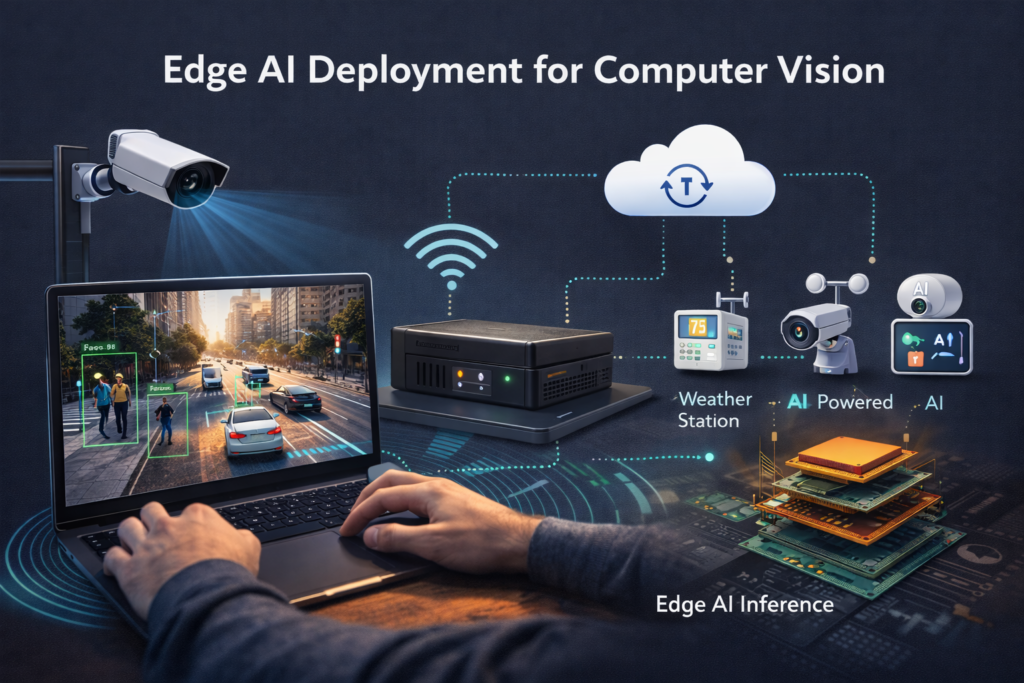
Edge AI computer vision (see Image 6) is powerful—but complex.
1. Latency Constraints
Real-time systems require:
- <100ms inference
- Efficient model architectures
- Hardware acceleration
2. Resource Limitations
Edge devices have:
- Limited RAM
- Lower GPU capacity
- Power constraints
Solutions:
- Quantization
- Pruning
- Model distillation
3. Privacy & Compliance
Local processing reduces:
- Data transmission
- Regulatory risk
Important for:
- Healthcare
- Surveillance
- Retail analytics
4. OTA Updates & MLOps
Managing thousands of edge devices requires:
- Model versioning
- Monitoring
- Auto-rollbacks
This is where cloud-native architecture + DevOps practices become critical.
Future Trends: Vision Transformers & VLMs
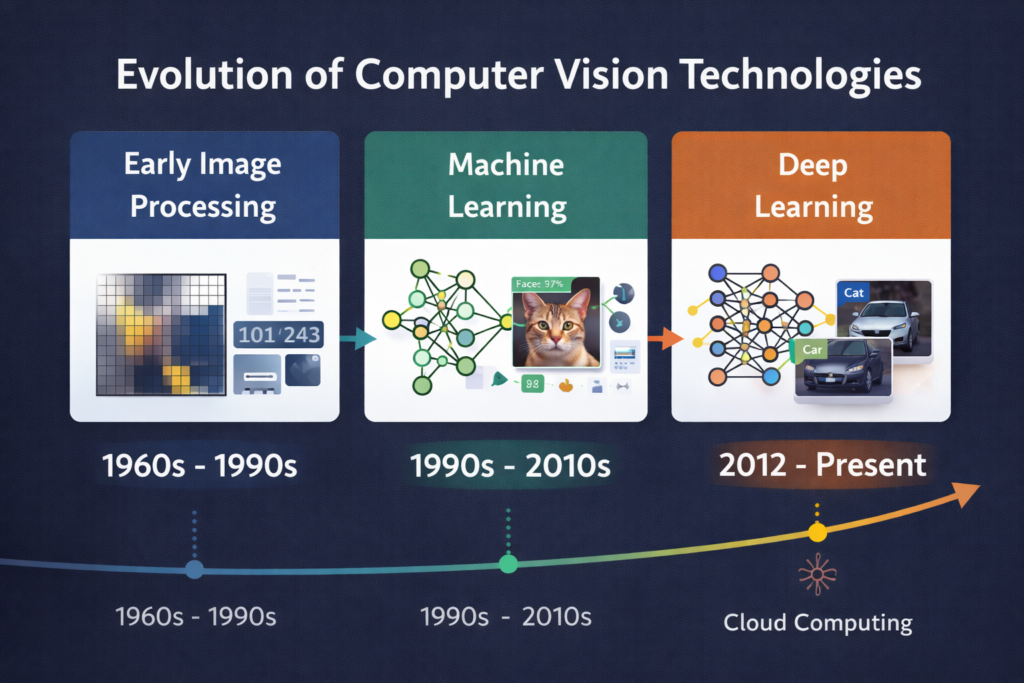
Computer vision has evolved rapidly (see Image 7).
From CNNs to Vision Transformers (ViTs)
Vision Transformers:
- Use attention mechanisms
- Capture global context
- Scale efficiently with data
Benefits:
- Better generalization
- Improved long-range dependency modeling
Vision-Language Models (VLMs)
These combine:
- Image understanding
- Natural language reasoning
Applications:
- Image captioning
- Visual question answering
- Multimodal search
This is redefining how SaaS AI platforms deliver insights.
Generative Vision Models
- Image generation
- Image editing
- Style transfer
- Synthetic training data
Huge for:
- Retail try-on
- Product previews
- Digital marketing automation

Leave a Reply